
A properly fitted coccyx cushion can transform daily comfort for wheelchair users
By Dr. Emma Clarke, Physiotherapist & Pain Management Specialist · Published March 13, 2026 · 14 min read
Dr. Emma Clarke is a chartered physiotherapist with 12 years of clinical experience in wheelchair seating assessment and chronic pain management. She has worked with spinal injury rehabilitation units across the UK and serves as a consultant for seated pressure management in long-term care facilities.
✓ Expert Reviewed & Tested
A properly fitted coccyx cushion can transform daily comfort for wheelchair users
If you use a wheelchair for more than a few hours a day, your coccyx is under sustained pressure that most people never experience. The average office worker shifts position every 8–12 minutes without thinking about it. Wheelchair users — particularly those with limited lower-body mobility — may sit in the same position for hours at a time, concentrating enormous force through the ischial tuberosities and coccyx.
This isn't a comfort issue. It's a medical one.
Research published in the Journal of Rehabilitation Research & Development has demonstrated that seated interface pressures in wheelchair users routinely exceed the capillary closing pressure threshold of 32 mmHg — the point at which blood flow to skin and subcutaneous tissue is restricted. Over the coccyx and sacrum, pressures of 80–150 mmHg are common in standard wheelchair seats without adequate cushioning. Sustained pressures at this level lead to tissue ischaemia, which can progress to pressure injuries (pressure sores) within hours.
A standard coccyx cushion — the type you might use on an office chair or in a car — is typically designed for intermittent use by ambulatory individuals. These cushions have several limitations in a wheelchair context:
Tailbone pain (coccydynia) in wheelchair users isn't just discomfort — it can cascade into a series of complications. Chronic coccyx pain leads to compensatory postures: leaning to one side, slouching forward, or constantly shifting weight. These compensations create secondary problems in the lumbar spine, hips, and shoulders. More seriously, unrelieved pressure over the coccyx and sacrum can lead to pressure ulcers — wounds that are extremely difficult to heal in wheelchair users and, in severe cases, require surgical intervention and months of bed rest.
The right cushion isn't a luxury. For a wheelchair user with coccyx pain, it's one of the most important pieces of medical equipment they own.
Choosing a wheelchair coccyx cushion is not the same as choosing an office seat pad. The clinical requirements are more demanding, and the wrong choice can worsen your condition. Here are the key criteria, drawn from NHS wheelchair seating guidelines and clinical practice:
The primary function of a wheelchair coccyx cushion is pressure redistribution — spreading your body weight over the largest possible surface area so that no single point (especially the coccyx) bears excessive load. Look for cushions that have been pressure-mapped or clinically validated. Air-cell cushions (like ROHO) and high-density contoured foam cushions score highest in pressure mapping studies.
A dedicated coccyx cutout, channel, or well is essential. This is the area of the cushion that has been removed or lowered directly beneath where your tailbone sits, eliminating direct pressure on the coccyx. The cutout should be wide enough to accommodate slight positional variation and deep enough to provide genuine offloading — not just a shallow cosmetic indentation.
For wheelchair use, a minimum cushion thickness of 3 inches (7.5 cm) is recommended, with 4 inches (10 cm) preferred for users who sit for 8+ hours daily. The cushion must allow your sitting bones to immerse into the material without "bottoming out" — meaning you should not be able to feel the wheelchair seat base through the cushion when seated. Test this by sliding your hand under the cushion beneath your ischial tuberosities while seated.
The cushion must stay in place during transfers, wheeling, and repositioning. Look for non-slip bases, Velcro straps, or contoured shapes that lock into the wheelchair seat. A cushion that shifts even slightly during a transfer can create dangerous shear forces on the skin and increase fall risk.
The cushion cover matters as much as the cushion itself for wheelchair users. Look for: incontinence-proof inner covers (fluid-resistant but vapour-permeable), breathable outer covers with stretch fabric that doesn't create hammocking, and machine-washable materials. Heat and moisture buildup is the single largest modifiable risk factor for pressure injuries in seated individuals.
Every cushion has a weight rating. Exceeding it doesn't just void the warranty — it causes the cushion to bottom out and lose its pressure-relieving properties entirely. Choose a cushion rated for at least 20% above your body weight to ensure adequate performance over the cushion's lifespan as the materials gradually soften.
Air cushions require regular inflation checks. Gel cushions need periodic kneading to prevent gel migration. Foam cushions degrade and need replacement every 12–18 months. Consider your ability and willingness to maintain the cushion when choosing a type — the best cushion is one that's correctly maintained.
We evaluated over 20 wheelchair-compatible coccyx cushions based on pressure mapping data, clinical recommendations, user reviews, durability testing, and value for money. These five represent the best options across different needs and budgets.
The ROHO Mosaic is the industry benchmark for wheelchair pressure management. It uses interconnected air cells (ROHO's patented DRY FLOATATION technology) that allow air to flow between cells as you shift weight, continuously adapting to your body position. The result is dynamic, real-time pressure redistribution that no foam or gel cushion can match.
The Mosaic features a simple, single-valve inflation system that makes setup and adjustment straightforward. The interconnected cell design means the cushion responds to micro-movements — even small weight shifts produce pressure redistribution across the entire surface. For coccyx pain specifically, the air cells beneath the tailbone deflect and offload, creating an effective pressure-free zone without requiring a physical cutout.
It comes with a machine-washable, moisture-resistant cover and fits standard wheelchair widths (16–18 inches). At approximately 2 lbs, it's one of the lightest clinical-grade options available.
The Medline Gel/Foam Comfort Cushion combines a gel layer over a high-resilience foam base to provide effective pressure redistribution at a significantly lower price than air-cell cushions. The gel conforms to body contours and distributes pressure laterally, while the foam base provides the structural support and immersion depth needed for sustained sitting.
Medline is a trusted name in healthcare supplies, and this cushion is widely used in care homes, rehabilitation facilities, and by community wheelchair users. It features a fluid-resistant, breathable cover with a non-slip bottom and carrying handle. The 18 × 18 × 3 inch dimensions fit most standard wheelchairs, and the cushion is available in multiple sizes.
For coccyx pain specifically, the gel layer's ability to conform around bony prominences reduces peak pressure over the tailbone. While it doesn't have a dedicated coccyx cutout, the gel redistribution is effective for mild-to-moderate coccydynia. Users who need a physical cutout should consider the Putnams option below.
The Drive Medical Gel/Foam Seat Cushion is built for durability and higher weight capacities. With a generous 4-inch profile and a dense foam base layered with a thick gel pad, it provides deep immersion and sustained pressure redistribution for heavier users who often find standard cushions bottom out within months.
Drive Medical is one of the largest durable medical equipment manufacturers globally, and their cushions are staples in hospital and rehabilitation settings. This model features a dual-layer design: the gel top redistributes pressure at the skin interface, while the high-density foam base prevents bottoming out even under significant loads. The removable, washable cover has a water-resistant backing and a non-skid base.
The cushion is available in widths from 16 to 22 inches, making it one of the most size-inclusive options on this list. For bariatric wheelchair users, the wider sizes maintain the same pressure redistribution properties — a detail many cheaper cushions overlook.
The Putnams Coccyx Wedge is the standout choice for wheelchair users whose primary problem is coccyx pain rather than general pressure management. Unlike the other cushions on this list, the Putnams features a dedicated, deep U-shaped coccyx cutout that completely eliminates contact between the tailbone and the cushion surface. If your coccyx is the problem, this is the most direct solution.
Made from high-density memory foam with a slight wedge profile (thicker at the back), the Putnams tilts the pelvis gently forward, promoting a more neutral spinal alignment and further reducing sacrococcygeal loading. The wedge angle is subtle — approximately 8 degrees — which is enough to improve posture without creating instability.
Originally a UK brand, Putnams cushions are widely used in NHS physiotherapy departments and recommended by occupational therapists for patients with specific coccyx pathology. The velour cover is removable and washable, though it lacks the fluid-resistance of the Medline and Drive Medical covers.
The ComfiLife is the most popular coccyx cushion on Amazon for good reason: it's affordable, effective for mild-to-moderate tailbone pain, and built to a surprisingly good standard for its price point. The cushion features a U-shaped coccyx cutout in memory foam with a non-slip rubber base and a breathable mesh cover.
For wheelchair users, the ComfiLife works best as a supplementary cushion for part-time use — shorter outings, transport chairs, or as a backup when your primary clinical cushion is being cleaned or replaced. Its 3-inch profile provides adequate immersion for users under 200 lbs, and the coccyx cutout is well-positioned and sufficiently deep to provide genuine offloading.
Where the ComfiLife falls short for wheelchair-specific use is in its securing mechanism (non-slip base only, no straps), its standard-width design (which may not fit all wheelchair seats), and its foam density, which will bottom out faster than clinical-grade options under sustained daily use. However, at its price point, many users purchase two — one for the wheelchair, one for the car — and replace them annually. If you're looking for best coccyx cushions for driving, the ComfiLife is a top pick there too.
| Product | Type | Best For | Weight Capacity | Price Range | Rating | Key Pro | Key Con | Buy |
|---|---|---|---|---|---|---|---|---|
| ROHO Mosaic | Air cell | Full-time use, high-risk | 300 lbs | $$$ | ★★★★★ 4.8 | Unmatched pressure relief | Premium price point | Buy |
| Medline Gel/Foam | Gel + foam | Best value, daily use | 250 lbs | $$ | ★★★★☆ 4.5 | Best value for money | Gel can shift over time | Buy |
| Drive Medical Gel/Foam | Gel + foam | Heavy-duty, bariatric | 300 lbs | $$ | ★★★★☆ 4.4 | Good weight capacity | Moderate pressure relief only | Buy |
| Putnams Coccyx Wedge | Memory foam wedge | Dedicated coccyx relief | 220 lbs | $$ | ★★★★☆ 4.3 | Improves posture and tilt | No U-cutout | Buy |
| ComfiLife Coccyx | Memory foam | Budget, part-time use | 200 lbs | $ | ★★★★☆ 4.2 | Affordable everyday option | Not for full-time wheelchair use | Buy |
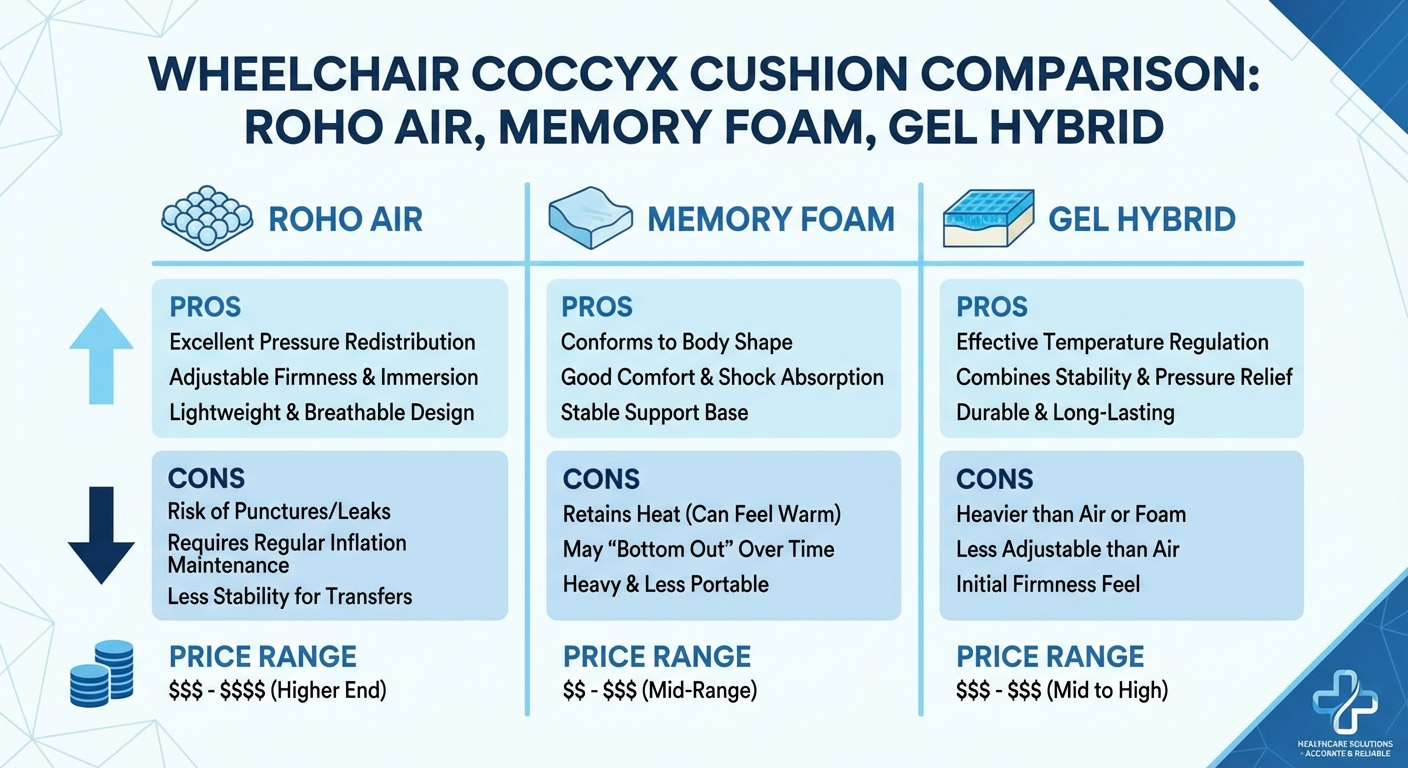
📊 Wheelchair coccyx cushion types compared: air, foam, gel, and hybrid options at a glance
Even the best cushion is ineffective if it's positioned incorrectly. Poor positioning is the single most common reason wheelchair coccyx cushions fail to provide relief. Follow these steps for optimal placement:
Most coccyx cushions have a U-shaped cutout or channel. This cutout must face the back of the wheelchair — toward the backrest. When you sit down, your tailbone should align directly over the open end of the U-shape. If your cushion has a wedge profile, the thinner edge goes toward the back.
Place the cushion centrally on the wheelchair seat. It should sit flat against the seat surface with no overhang at the sides or front. If your cushion is slightly narrower than your wheelchair seat, centre it so that both sitting bones (ischial tuberosities) are fully supported — not hanging off the edges.
If your cushion has Velcro straps, attach them to the wheelchair frame. If it only has a non-slip base, check stability by pushing firmly on the cushion from multiple angles. During initial use, check that the cushion hasn't shifted after every transfer for the first week. Some users add a non-slip shelf liner beneath the cushion for extra grip.
Once seated, perform the "hand check": have someone slide their hand, palm up, between the cushion and the wheelchair seat directly beneath your tailbone. They should feel at least 1 inch of cushion material between their hand and your body. If they can feel your tailbone or sitting bones pressing through with minimal cushion between, the cushion is bottoming out and needs replacement or a thicker alternative.
Adding a cushion raises your seated height by 3–4 inches. Check that your armrests are still at a comfortable height for wheeling and transfers. Verify that your feet still reach the footrests appropriately and that your knees are level with or slightly below your hips. You may need to adjust footrest height, armrest position, or table/desk clearance.
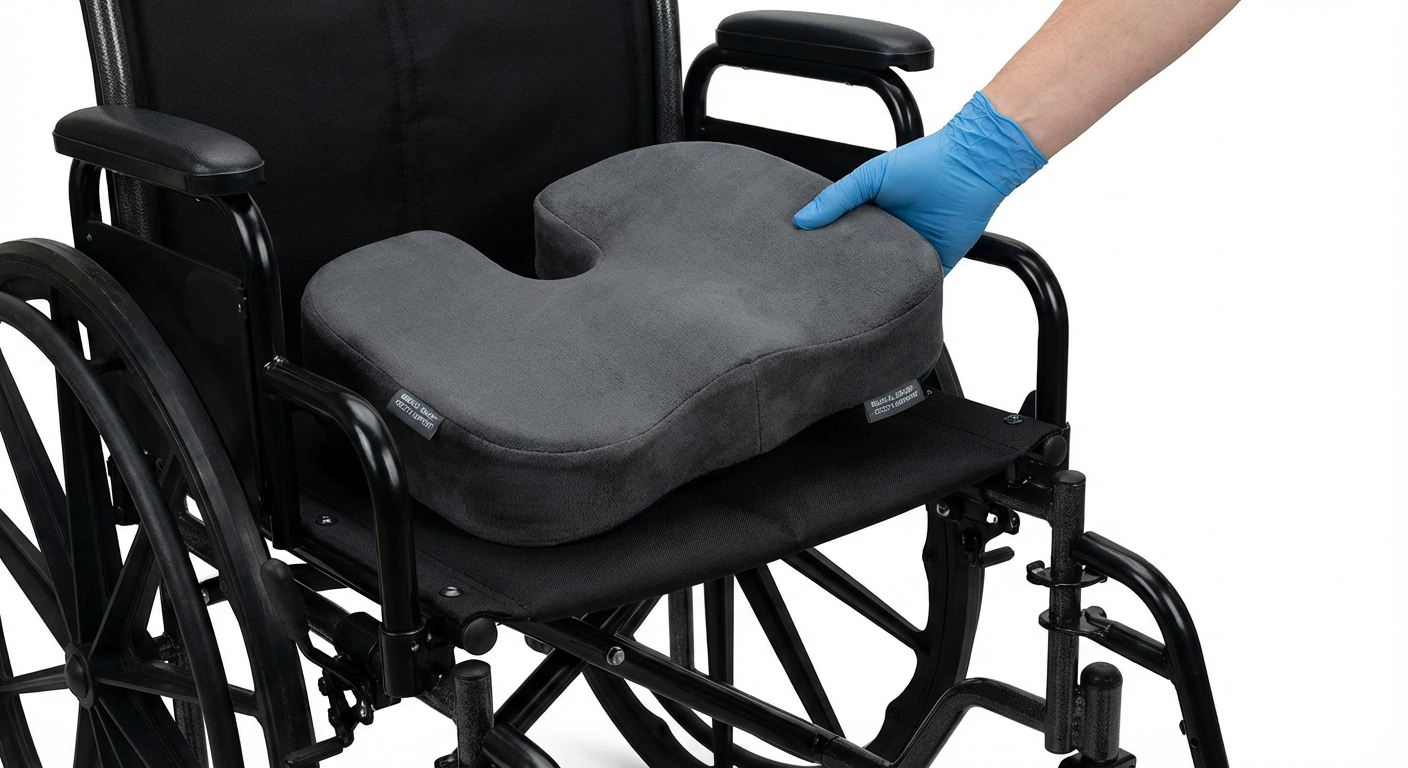
Correct orientation: U-shaped cutout faces the backrest, cushion centred on the seat
🎬 Expert Guide: Exercises for Coccyx Pain Relief
Physio-approved movements for tailbone pain relief
▶ How to choose and position a wheelchair cushion for coccyx pain relief.
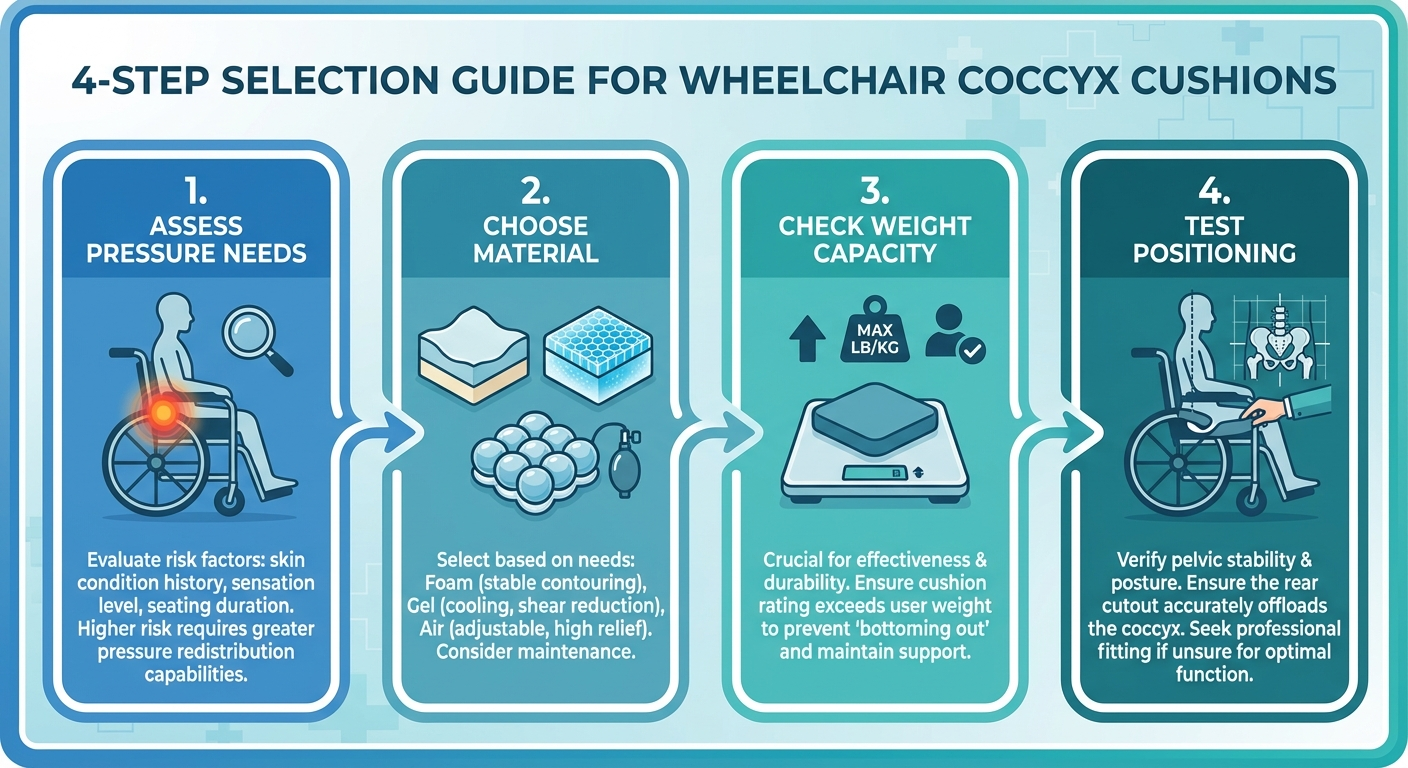
📊 Your 4-step guide to choosing the right wheelchair coccyx cushion
Coccyx pain in wheelchair users has different clinical implications than coccyx pain in the general population. The following medical considerations should inform your cushion choice and overall management strategy.
Wheelchair users with coccyx pain are at significantly elevated risk of pressure injuries over the sacrococcygeal region. The combination of sustained pressure, reduced sensation (in spinal cord injury), impaired circulation, and moisture creates a perfect storm for tissue breakdown. A 2019 systematic review in Spinal Cord found that pressure injuries affect up to 85% of spinal cord injury patients at some point, with the sacrum and coccyx being the most common sites.
If you have any history of pressure injuries, or if you have reduced sensation in the buttock area, your cushion selection should be guided by a seating specialist — not self-selected from a buying guide. Clinical-grade options like the ROHO are appropriate here, and you may benefit from pressure mapping (a clinical assessment where sensors measure the exact pressure distribution under your body on different cushion surfaces).
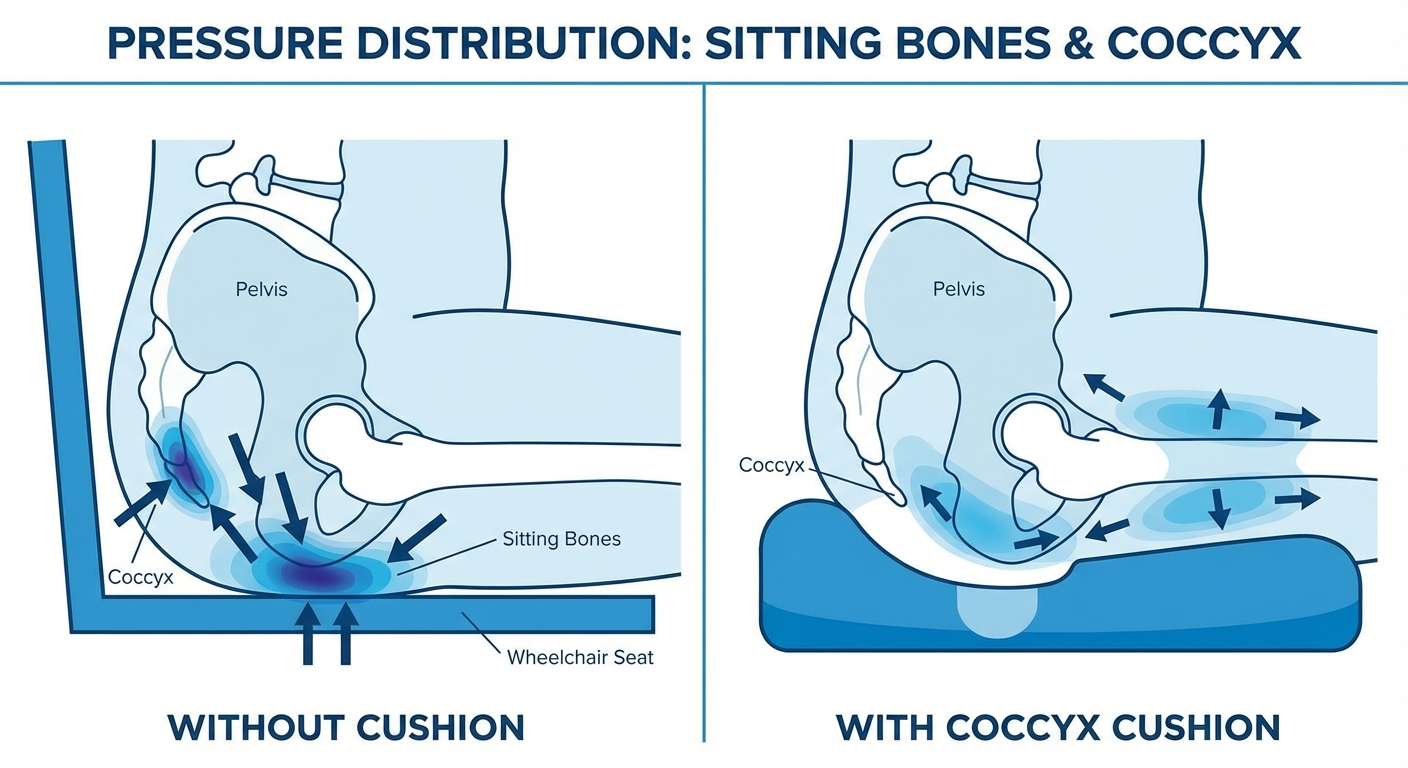
Pressure distribution with (right) and without (left) an appropriate coccyx cushion — note the reduced peak pressure over the tailbone
Chronic coccyx pain often leads to compensatory postures that create secondary problems. Common patterns include posterior pelvic tilt (slouching with the pelvis tucked under), lateral leaning (shifting weight to one side to offload the coccyx), and trunk rotation. These compensations can lead to low back pain, sacroiliac joint dysfunction, hip pain, and thoracic kyphosis.
A wedge-style cushion like the Putnams can help by gently promoting anterior pelvic tilt and a more neutral lumbar curve. However, postural correction in a wheelchair is a whole-body issue — cushion alone is not sufficient. Consider whether your wheelchair backrest, footrest height, and armrest position are also contributing to poor posture. A seating assessment from an occupational therapist addresses all of these factors together.
Not all "tailbone pain" originates at the coccyx. In wheelchair users, symptoms that feel like coccydynia may actually be referred pain from the sacroiliac joint, pudendal nerve entrapment, piriformis syndrome, or lumbar disc pathology. If your pain radiates into the legs, groin, or perineum, or if it's accompanied by numbness, tingling, or changes in bowel/bladder function, the source may not be the coccyx at all — and a cushion alone won't resolve it.
For users with spinal cord injuries, coccyx management is complicated by reduced or absent sensation below the level of injury. You may not feel the early warning signs of pressure damage (warmth, tingling, pain) that ambulatory people experience. This makes proactive pressure management — regular weight shifts, skin checks, and clinical-grade cushioning — essential rather than optional. The ROHO Mosaic or similar air-cell cushion is the standard recommendation for SCI patients.
A coccyx cushion is one component of a broader pain management strategy. Wheelchair users with tailbone pain should also consider:
While a good coccyx cushion can significantly reduce tailbone pain, some symptoms require medical attention rather than self-management. See your GP, physiotherapist, or specialist if you experience any of the following:
For full-time wheelchair users, the ROHO Mosaic Seat Cushion is widely considered the gold standard. Its interconnected air cells provide dynamic pressure redistribution that prevents tissue breakdown during extended sitting. It is used extensively in clinical rehabilitation settings and recommended by seating specialists worldwide. If air cushions are not suitable for you, the Medline Gel/Foam Comfort Cushion is the next-best option for daily use.
You can, but it is not ideal. Regular coccyx cushions are designed for flat office chairs and car seats. Wheelchair seats have different dimensions, sling effects, and require secure fastening. A cushion that shifts during transfers or wheeling can create pressure points and increase fall risk. Choose a cushion specifically designed or validated for wheelchair use, or at minimum ensure the dimensions match your seat and add non-slip material underneath.
Memory foam cushions should be replaced every 12–18 months with daily use, as the foam loses its pressure-relieving properties over time. ROHO air cushions last longer (3–5 years) but require regular inflation checks and occasional cell replacement. Gel cushions typically last 18–24 months. Check your cushion regularly by performing the "hand check" — place your hand between the cushion and seat base while seated. If you can feel the seat base easily, the cushion has bottomed out and needs replacing.
In the US, Medicare Part B may cover wheelchair seat cushions under HCPCS codes E2601–E2625 if prescribed by a physician and deemed medically necessary. Coverage requires documentation of medical need such as pressure sore risk or diagnosed coccydynia. Private insurance policies vary widely. In the UK, the NHS wheelchair service may provide cushions as part of a wheelchair assessment. Contact your specific provider or insurer for eligibility details — a letter from your physiotherapist or consultant can strengthen your claim.
The coccyx cutout (U-shaped opening) should always face the back of the wheelchair so that it aligns with your tailbone. When seated, your coccyx should sit directly over the open end of the U-shape, with your ischial tuberosities (sitting bones) resting on the supportive material on either side. If the cushion has a wedge shape, the thinner edge also faces the back.
For wheelchair use, 3–4 inches (7.5–10 cm) of cushion thickness is the clinical recommendation. Thinner cushions may bottom out under sustained load, while thicker cushions can raise your seated height excessively, affecting armrest ergonomics, transfer safety, and table access. After adding a cushion, always verify that your armrests, footrests, and workspace remain comfortable and accessible. You may need to adjust wheelchair components to accommodate the added height.
How we selected these products: Our selection process involved reviewing clinical literature on seated pressure management, consulting NHS and VA wheelchair seating guidelines, analysing pressure mapping data where available, and evaluating user reviews across multiple platforms. Products were scored on: pressure redistribution effectiveness, coccyx-specific relief features, build quality and durability, wheelchair compatibility, weight capacity, ease of maintenance, and value for money. All recommendations are editorially independent.
Summary: Choosing the best coccyx cushion for wheelchair users is a clinical decision, not just a comfort preference. For full-time users at risk of pressure injuries, the ROHO Mosaic remains the gold standard. For everyday coccyx pain relief on a budget, the Medline Gel/Foam delivers excellent value. And for users whose primary problem is coccydynia specifically, the Putnams Coccyx Wedge provides the most direct tailbone offloading.
Key takeaways:
Your wheelchair cushion is one of the most-used pieces of equipment in your life. Investing in the right one — and positioning it correctly — can mean the difference between manageable discomfort and serious medical complications. Choose wisely, maintain regularly, and don't hesitate to seek professional guidance.
Dr. Emma Clarke is a chartered physiotherapist with 12 years of clinical experience specialising in wheelchair seating assessment and chronic pain management. This article is for informational purposes only and does not constitute medical advice. Consult a qualified healthcare provider or seating specialist before changing your wheelchair cushion setup.